
Not medically reviewed. This guide explains source reading and does not assess treatments.

 Peptide Evidence Book
At a glance
Separate the recruitment status, estimated target, actual enrollment and analysis count. Read how the protocol defines each participant stage.
In this guide
Recruitment is the process of finding and inviting potential participants. Enrollment counts participants under the study’s stated definition. A registry can report an estimated enrollment target or an actual enrolled number. To compare it with a paper, keep that label visible and check the participant-flow stage the paper counted.
Start with the registry status and count type
Open the record for the study you are reading. Match the registry identifier in the paper and registry before comparing totals. Record the date of the registry version, recruitment status and the enrollment count together. “Recruiting” is a status. It does not tell you how many people have been screened or admitted. An estimated enrollment number describes a target, even when presented beside a recruitment status.
Actual enrollment records a participant count. Confirm whether the record you are looking at has been updated to actual. If you are reading an older version, the difference may be a revision to the target or a change from estimated to actual.
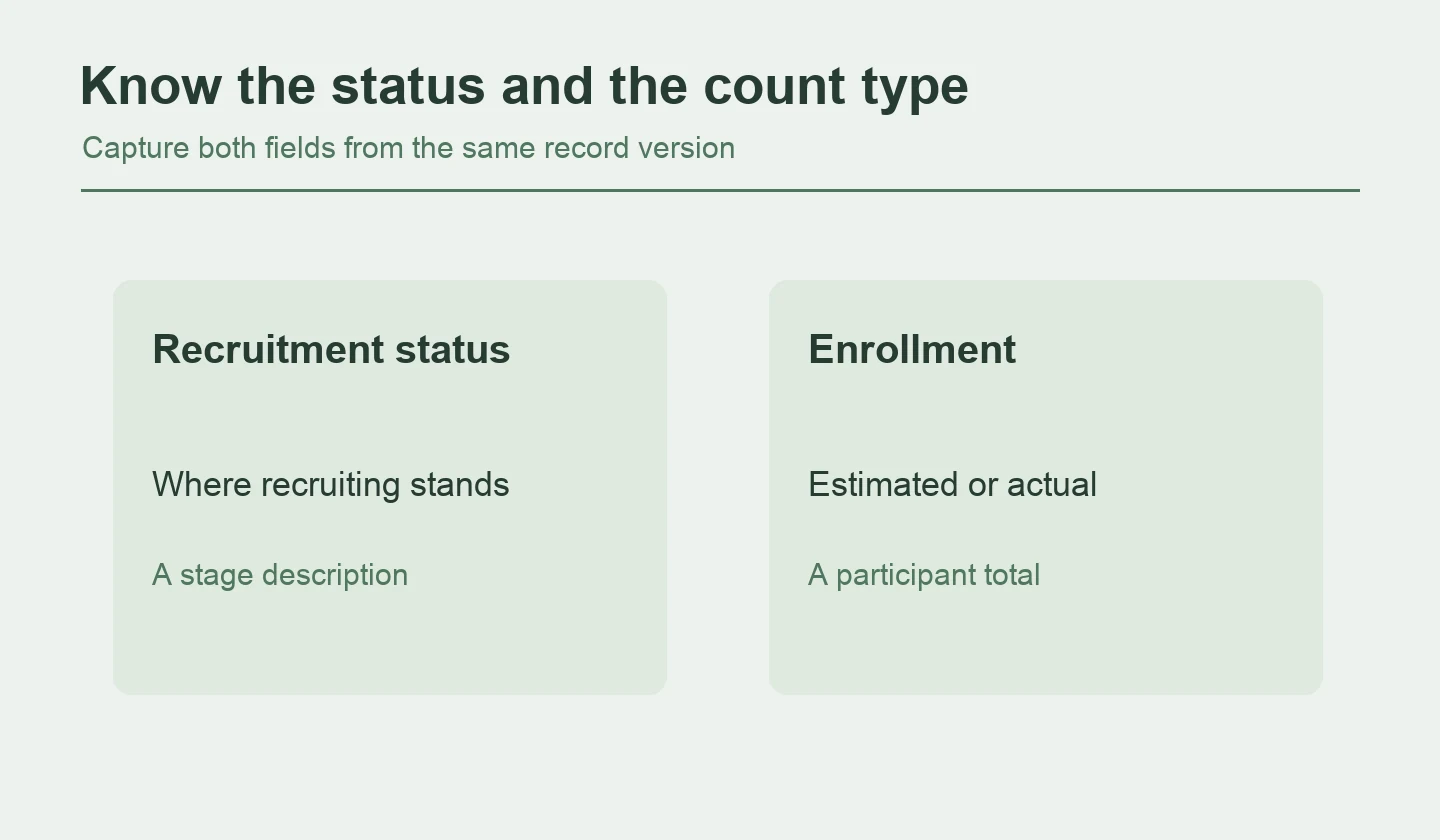
Two separate fields in the registry
Recruitment status
The stage of recruiting for the study.
Enrollment type and number
An estimated target or an actual enrolled count.
Check the current terminology in Glossary terms.
Sources: Glossary terms · Frequently asked questions about registration and results
Check the protocol’s enrollment point
A trial might screen people before they become study participants or follow an enrollment definition described in the protocol. The ClinicalTrials.gov policy FAQ explains why the protocol matters when one consent document covers both screening and participation. Do not assume that everyone who signed a consent form was included in the same way in every study.
Look up the screening and eligibility sections. Then read what the paper calls enrolled, randomized, assigned or analyzed. These terms identify different events. If the papers’ definitions are unclear, write down the original labels and leave the equivalence unresolved.
Sources: ClinicalTrials.gov · CONSORT 2025
Trace one fictional participant flow
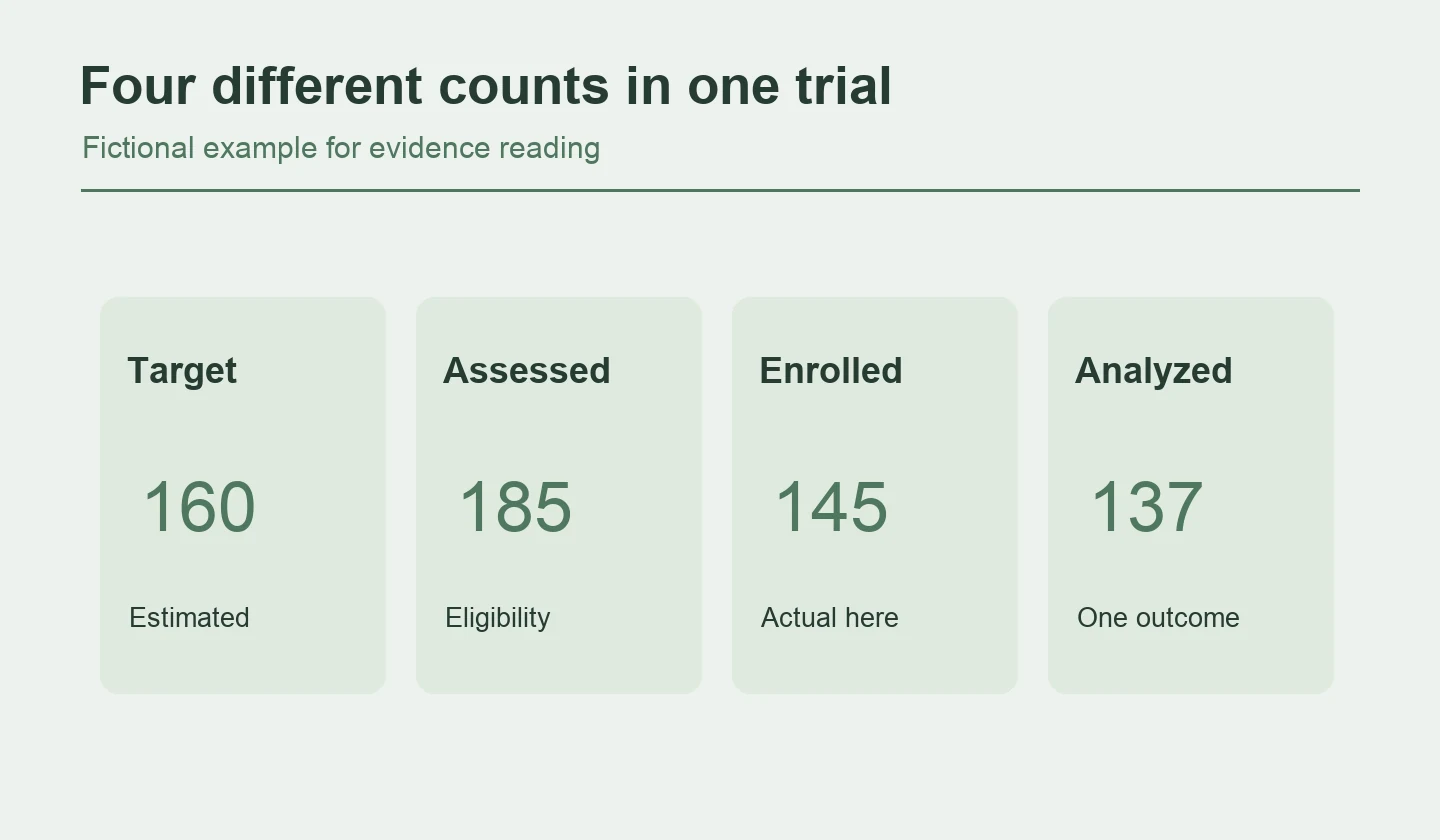
A fictional trial aims to enroll 160 people. Its report says that 185 people were assessed for eligibility. Forty were excluded before the trial’s enrollment point, leaving 145 enrolled. In this fictional protocol all 145 enrolled participants were then randomized, 72 to one group and 73 to the other. The primary outcome was analyzed for 137 people.
Record “160 estimated,” “185 assessed,” “145 enrolled and randomized in this example,” and “137 analyzed for the primary outcome.” They are four different observations. The fact that enrollment and randomization are equal in this fictional protocol tells you nothing about whether those numbers match in another trial.
| Field | Count | What it describes |
|---|---|---|
| Estimated enrollment | 160 | Target |
| Assessed | 185 | People assessed for eligibility |
| Enrolled and randomized here | 145 | Actual count at those matching stages in this example |
| Analyzed | 137 | Primary-outcome analysis in the example |
Sources: ClinicalTrials.gov · CONSORT 2025
Locate the next number rather than inferring it
Find the flow diagram, methods and results tables together. CONSORT calls for each group’s counts for assignment, receipt of the intended intervention and analysis for the primary outcome. If the figure reports losses or exclusions, keep their timing and reasons with the count. If the figure does not give an earlier screening denominator, mark it as not reported. Do not infer it from the enrollment target.
An active record and a later paper can refer to different time cuts or analysis populations. Confirm the record date and what each count represents before calling the difference a contradiction.
Read which participant counts are reported in Item 22a: Numbers included.
Sources: Item 22a: Numbers included · Item 22b: Losses and exclusions
Write a denominator you can use again
Save the registry record version and the source for each count. Include the study stage, timing, definition and whether the number is estimated or actual. If the analysis count differs from the randomized count, identify the named analysis and outcome. That makes the next person’s evidence check reproducible without treating a recruitment goal as a clinical result.
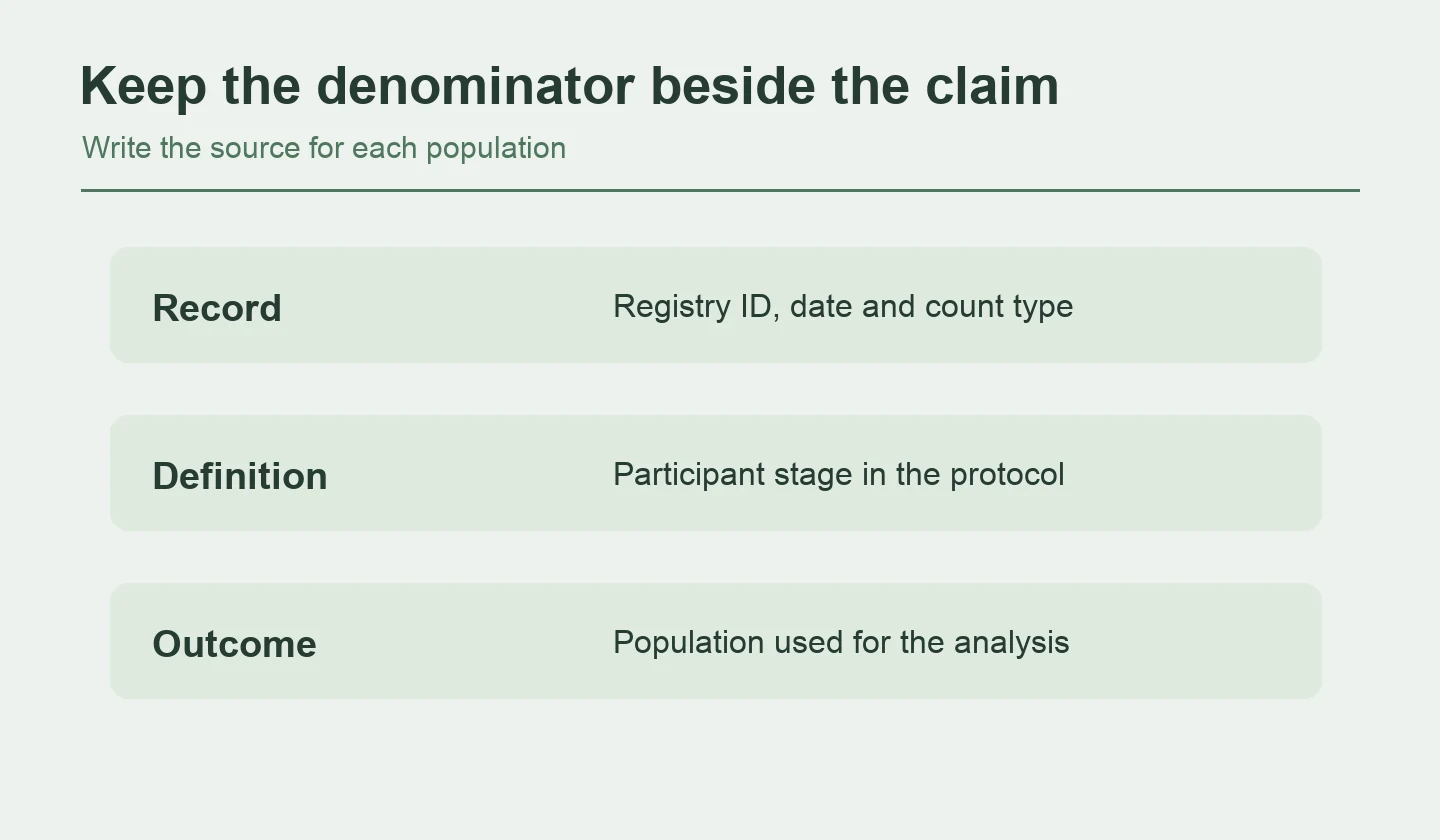

Save the source of each denominator
- Match the registry identifier.
- Note version date, status and count type.
- Read the protocol and flow stages.
- Keep unavailable stage counts open.
For the related task, see Label the two evidence types.
Sources: ClinicalTrials.gov · Item 22a: Numbers included · Item 22b: Losses and exclusions
Frequently asked questions
Does every person approached enter the enrollment count?
Recruiting and enrolling describe different events. Read the protocol and report for the study’s enrollment definition.
Are enrolled and randomized always the same?
Some reports show different totals. Keep the stages separate unless the study documents the match.
What does estimated enrollment mean?
It is the target participant count. Check whether a later record reports actual enrollment.
What if the paper does not report how many were screened?
Record it as unavailable. The target and analyzed count cannot fill in that denominator.
Peptide Evidence BookFind how the protocol defines eligibility
Record which criteria apply before counting participants.
Match the study record and publicationContinue with a related guide
- Find how the protocol defines eligibility
Record which criteria apply before counting participants.
- Label the two evidence types
Record what each evidence object supports separately.
- Read the named analysis population
Identify the denominator used for the claimed result.
References
- Glossary terms ClinicalTrials.gov
- Frequently asked questions about registration and results ClinicalTrials.gov
- Item 22a: Numbers included CONSORT 2025
- Item 22b: Losses and exclusions CONSORT 2025