
Not medically reviewed. This guide explains source reading and does not assess treatments.

 Peptide Evidence Book
At a glance
An intention-to-treat approach keeps participants in their original assigned groups. A per-protocol analysis generally applies a stated protocol eligibility or adherence rule. Check how each analysis handles missing outcomes.
In this guide
Intention-to-treat preserves the assignment a participant received when the study randomized them. Per-protocol analyses generally apply a rule about who followed the study protocol. A paper may also have incomplete outcomes, which affect who has a measured result. Follow the denominators through the report to see how the authors handled each of these questions.
Read the question behind the analysis
Start with the methods section. A comparison that asks about the effect of assignment follows people in the groups to which they were originally allocated, even if their experience after assignment differed. For example, a person assigned to group A may have stopped using whatever the trial asked them to use. Their original group is still A.
A conventional per-protocol result might restrict the analysis to people meeting a stated adherence requirement and other protocol criteria. That can change who contributes to the result and why. A restricted result does not automatically estimate the effect of adhering without bias. The Cochrane chapter explains why deviations and how researchers handle them can matter for interpreting either analysis.
Read the two rules separately
Original assignment
Ask where participants are grouped for the analysis and how the study handles their outcomes.
Protocol rule
Ask what deviations or adherence criteria govern inclusion in the per-protocol set.
Check the distinctions in the Handbook chapter 8: assessing risk of bias in a randomized trial.
Sources: Cochrane
Follow one set of figures through both groups
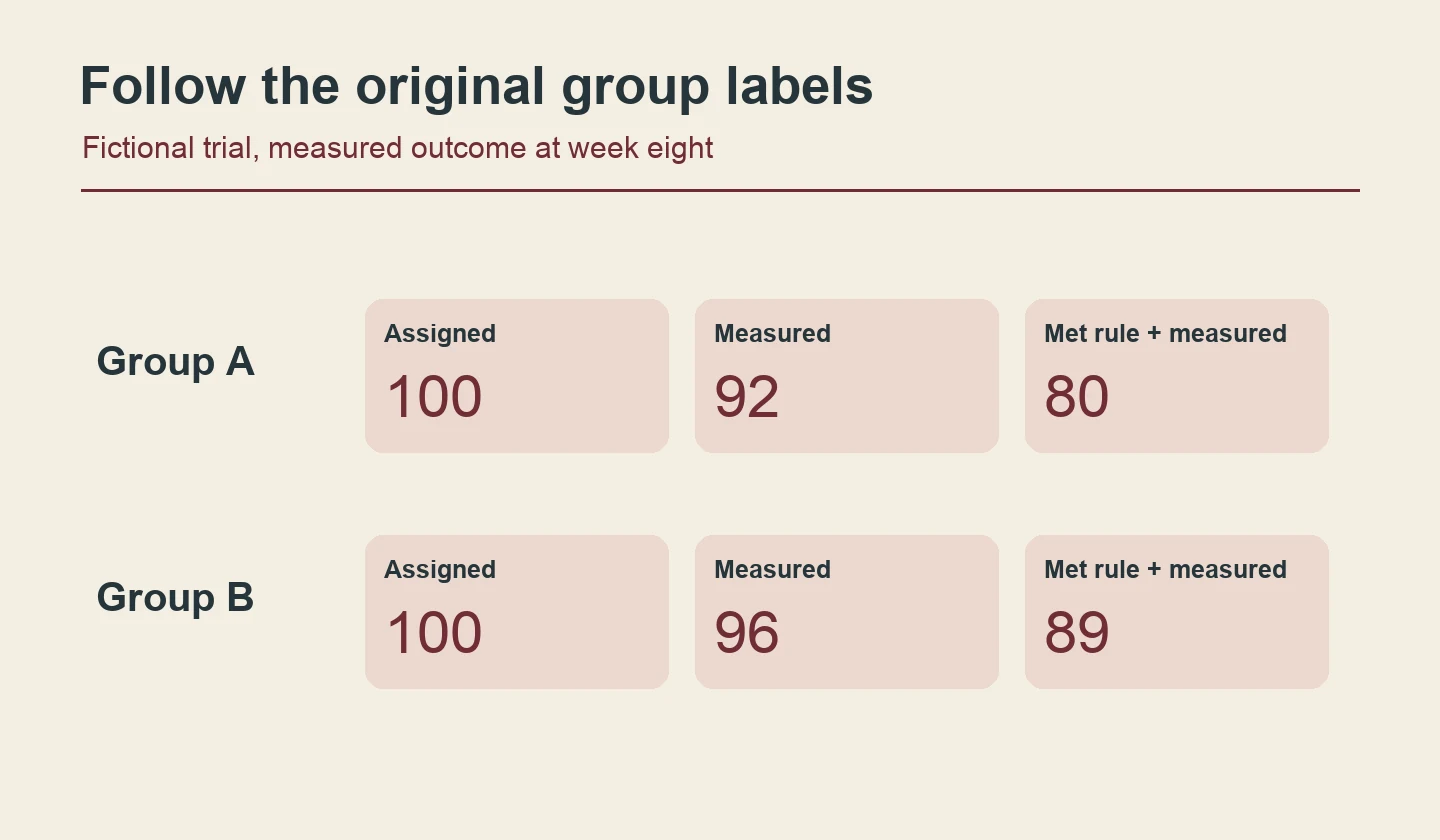
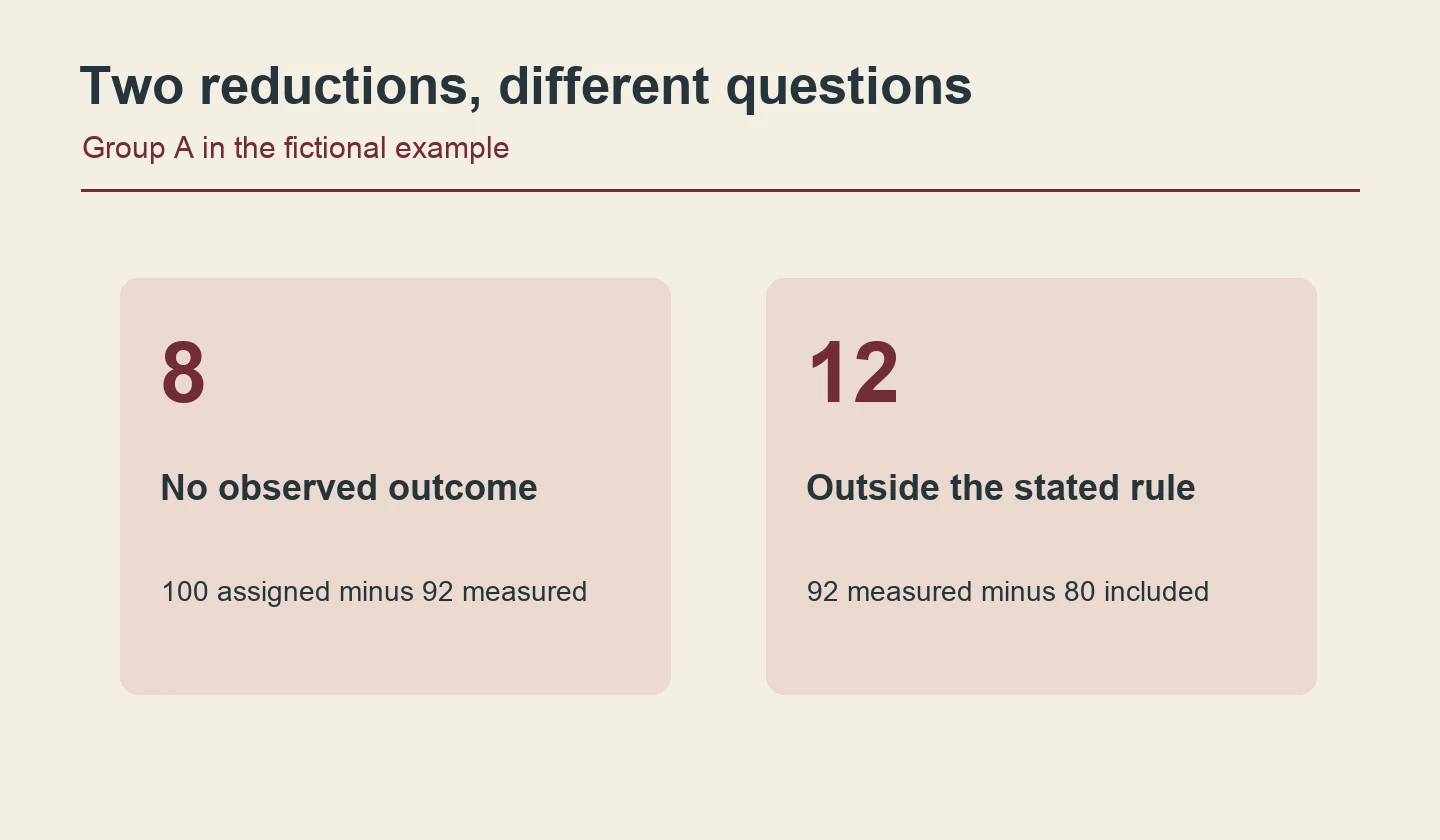
In the fictional example, A and B each begin with 100 randomized participants. By the week-eight measurement, A has 92 observed outcomes and B has 96. The difference between 100 and 92 tells you that eight assigned participants in A lack that outcome in this table. In B, the equivalent number is four. Save these counts with the outcome name. A different measurement time could have different availability.
Among the measured outcomes, 80 in A and 89 in B also meet the fictional protocol rule. In A, the 12 measured participants outside that set are 92 minus 80. In B, there are seven. The source rules should account for those reductions separately from the unobserved results.
| Stage | Group A | Group B |
|---|---|---|
| Randomized | 100 | 100 |
| Outcome recorded | 92 | 96 |
| Recorded outcome and protocol rule met | 80 | 89 |
Compare the reporting requirements in CONSORT 2025 item 26: numbers analysed.
Sources: CONSORT 2025 item 26: numbers analysed · CONSORT 2025 item 22a: numbers included
Locate the two ways a count can shrink
Suppose an abstract describes its comparison as intention-to-treat. The results table presents observed data for 92 and 96 participants. Ask how the analysis handled the unavailable outcomes. Some methods can include a participant using available data even without that last measurement. Authors can also report a comparison using only available data. The observed count alone cannot tell you which method they used.
Next inspect the protocol rule. In our example, the count applies only to people with a recorded outcome. An actual trial may define eligibility for the per-protocol population first and then handle missing outcomes within that population. Set up your note to follow the study’s documented order, even when it differs from the teaching example.
Sources: CONSORT–SPIRIT · Cochrane
Read the stated rules behind each label
Look for heading and footnote pairs: “analysis populations” in the methods, then the notes beneath the primary outcome. A label such as “modified ITT” does not explain who was excluded. The footnotes may define a requirement such as receiving the assigned intervention at least once or having a baseline measurement. Save the exact rule because different papers can use the same heading for different sets.
It is also worth noting whether the protocol or analysis plan defined the rules before the authors saw the results. If you find inconsistent descriptions, keep both and mark the discrepancy for review. Resist back-solving the rule from the size of the set alone.

Sources: CONSORT–SPIRIT · Cochrane
Make an evidence note that reconciles
Write the assignment denominator, observed outcome count and analysis population for each group. Include the outcome and time point and a link to the relevant table. Where the study reports a reason, keep it beside the affected count. Mark any part of the flow the sources leave unexplained.
Now compare the two result tables with the note in view. A difference between estimates can prompt a closer look at the people and methods represented in each. The change alone does not identify which estimate is correct or by how much the result may be biased.
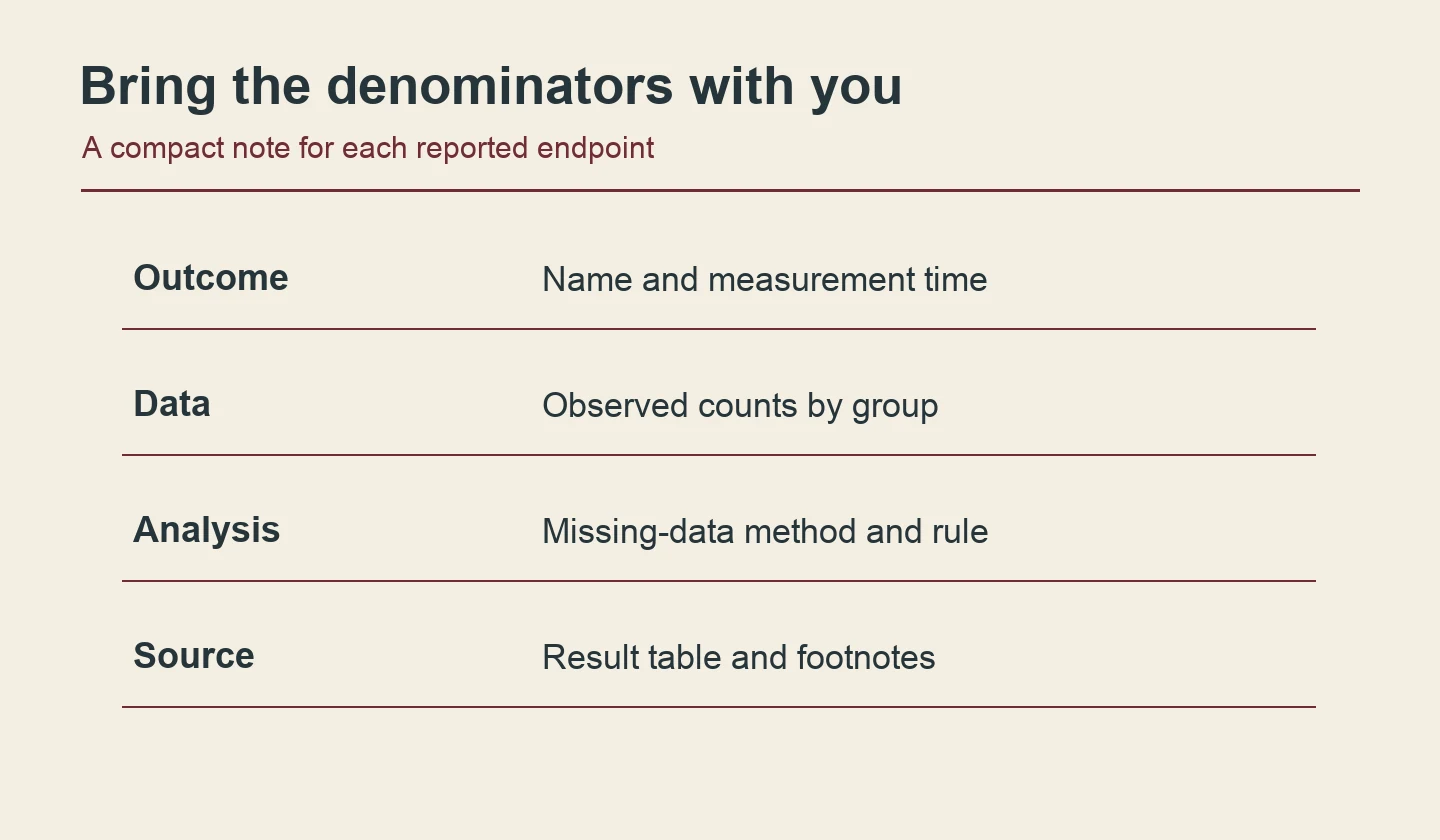
Record each denominator before comparing results
- Find the original group counts.
- Write the outcome and time point.
- Copy missing-data handling and any restrictions.
- Check that the counts in the table reconcile with the reported rules.
For the related task, see Check how attrition can affect a comparison.
Sources: CONSORT 2025 item 26: numbers analysed · CONSORT 2025 item 22a: numbers included
Frequently asked questions
Does intention-to-treat automatically fill in missing measurements?
No. Read the stated method for handling unavailable measurements and how many outcomes were observed.
Is a modified intention-to-treat population defined the same way in every paper?
Definitions vary. Read the inclusion and exclusion rules rather than relying on the label.
Is a per-protocol estimate always less biased?
Selection after randomization can make the groups harder to compare. Read the target effect, exclusions and method.
Where should I look if the abstract gives neither denominator?
Start with the methods, flow diagram and results table for the exact endpoint. Check the supplement or analysis plan for missing details.
Peptide Evidence BookRead the loss-to-follow-up guide
Keep follow-up status separate from adherence criteria.
Trace the missing outcomesContinue with a related guide
- Read the loss-to-follow-up guide
Keep follow-up status separate from adherence criteria.
- Check how attrition can affect a comparison
Review why a missing result matters for interpretation.
- Identify the primary and secondary outcomes
Find the exact endpoint before recording its denominator.
References
- Handbook chapter 8: assessing risk of bias in a randomized trial Cochrane
- CONSORT 2025 item 26: numbers analysed CONSORT–SPIRIT
- CONSORT 2025 item 22a: numbers included CONSORT–SPIRIT