
Not medically reviewed. This guide explains source reading and does not assess treatments.

 Peptide Evidence Book
At a glance
Divide the defined enrollment count by the matching time. For an active site-month rate, add each site’s actual open recruiting time before dividing.
In this guide
A trial enrollment rate needs a defined event and a unit of time. A trial that enrolls 30 people in five months averages six enrollments per month overall. To compare sites, divide the same count by the combined months those sites were open for recruitment. An enrollment total in a registry rarely tells you enough to do both calculations.
Name the numerator before dividing
Read how the report defines enrollment. Some reports count people who met the conditions to join, while a published review of randomized trials counted people who were recruited and randomized. Check whether your source reports those stages separately. Enrollment, screening, consent and randomization can produce different counts from the same program.
Copy the count with its exact definition and date range. If the registry gives a planned enrollment and the report gives a final count, put them on different lines in your notes. A target can help you assess whether the trial recruited as planned. It cannot establish the actual pace by itself.
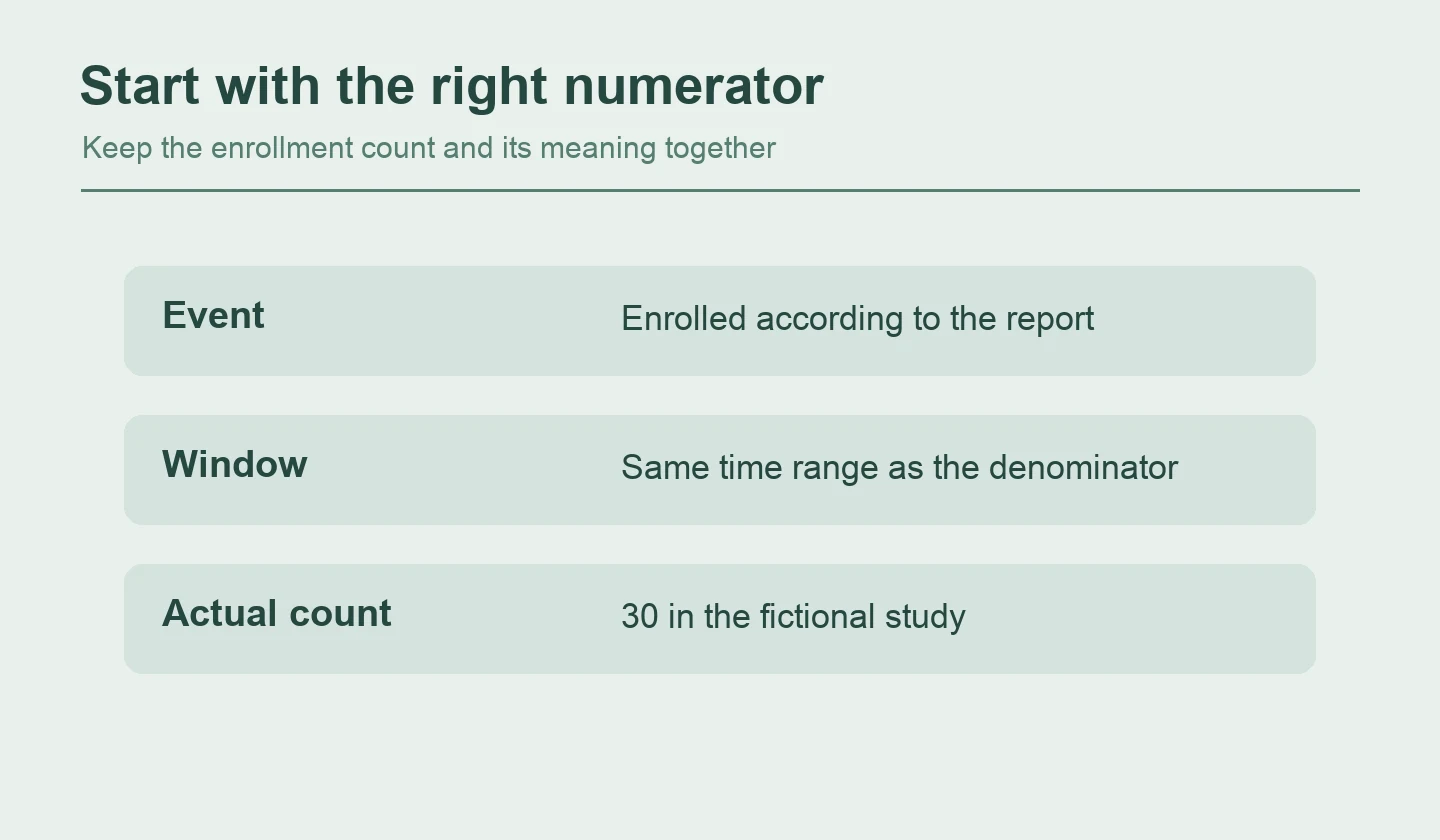
For an example with a defined rule for counting recruits, see Recruitment, Consent and Retention in Randomized Trials Published in the NIHR Journals Library.
Sources: BMJ Open · Journal of Clinical Medicine
Match months to the site opening dates
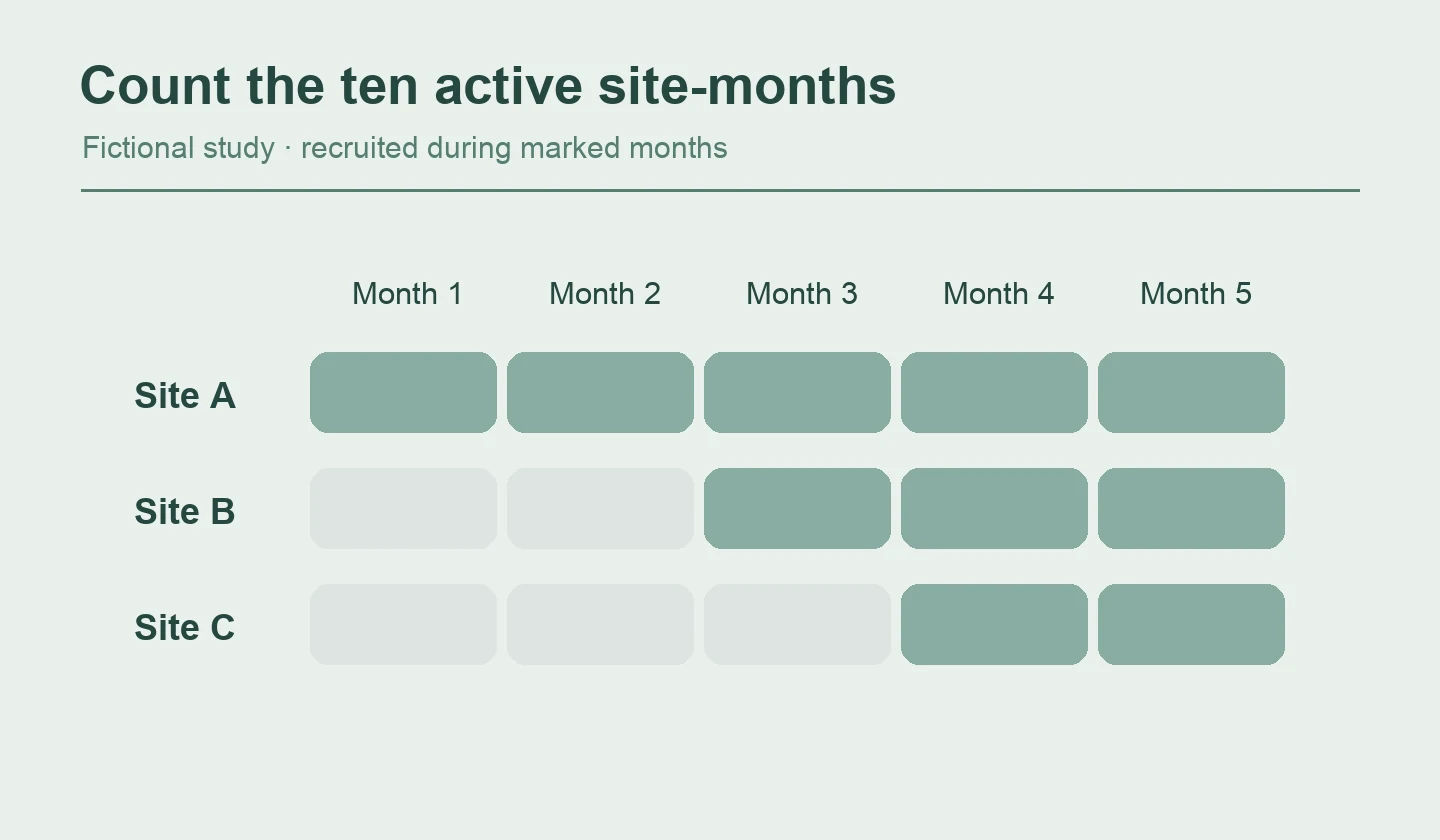
Consider a fictional study with three recruiting centers. A enrolls 10 people across five months. B enrolls 12 in three months and C enrolls eight in two months. B and C open later within the same five-month trial window. The combined recruiting time is 5 + 3 + 2 = 10 site-months, and the enrollment count is 10 + 12 + 8 = 30. The rate across the active sites is 30 ÷ 10 = 3 enrollees per site-month.
If you instead multiply three sites by the five months from first opening to the end of recruitment, the denominator becomes 15. The result is 2 per site-month. That shortcut attributes recruiting time to sites that were still closed. It can be reported as a rough estimate if you label how you obtained it. It answers a different question from the calculation using each site’s actual open period.
| Site | Enrollment | Active months |
|---|---|---|
| A | 10 | 5 |
| B | 12 | 3 |
| C | 8 | 2 |
| Total | 30 | 10 |

Divide total enrollment by active site-months
Enrollment rate
Use the same sites and window for the count and open months. This worksheet accepts whole months. Keep partial month calculations in the source convention.
Sources: BMJ Open
Read three useful rates without mixing them
The five-month trial averages six enrollees per calendar month across all centers. It also averages three per active site-month. For center B alone, the rate is 12 ÷ 3 = 4 per active month. All three figures describe the same fictional dataset. The unit tells you which question each figure answers.
Do not take a simple average of the three site rates to recreate the pooled rate. A short site opening and a long opening would get equal weight in that average. Here, the total-count method weights the sites by their actual open time. Keep pauses and partial months consistent with the source, and record what was included instead of silently guessing a missing open date.
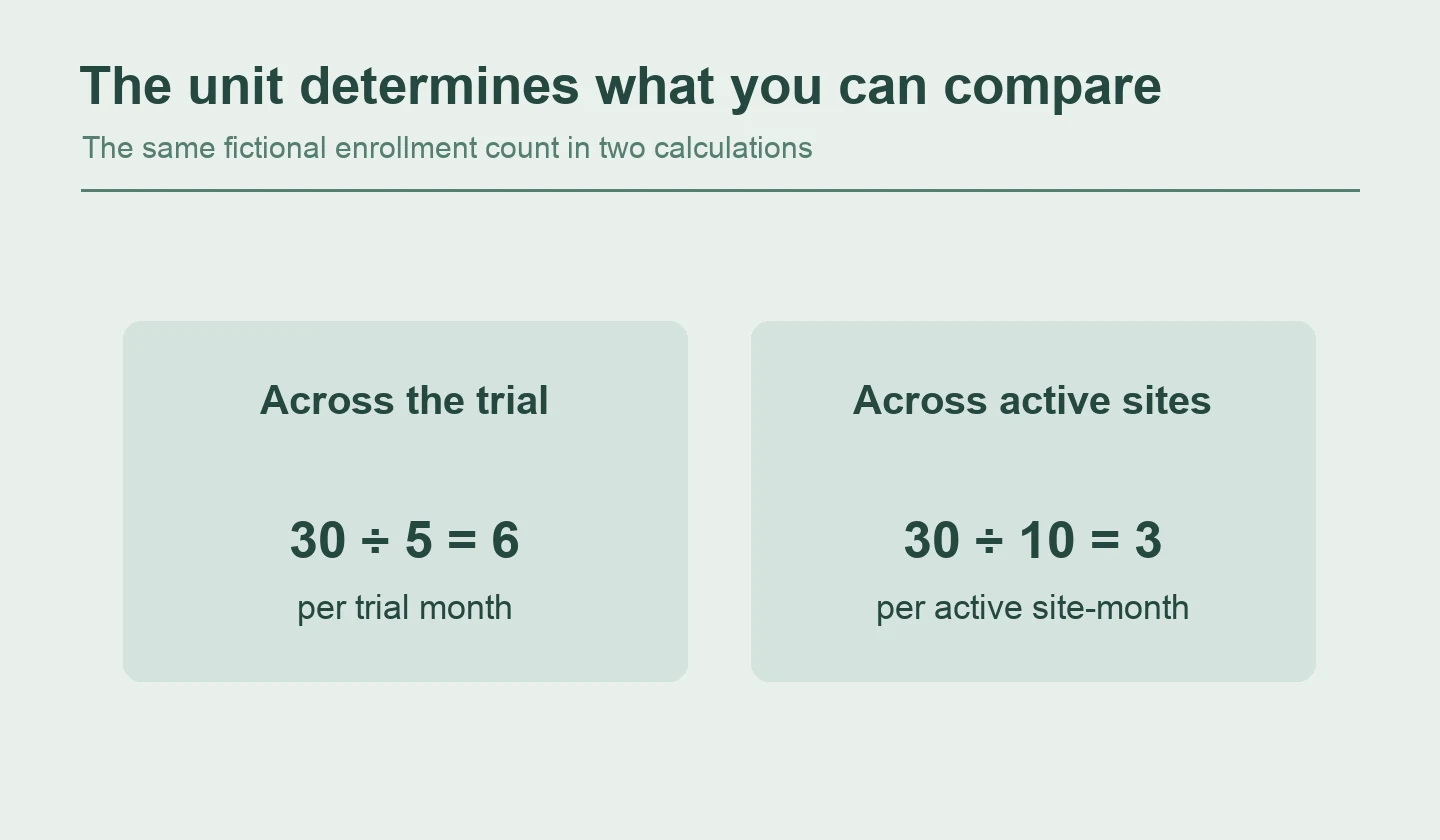
Same enrollment count, different time units
Trial calendar month
30 people across 5 months = 6 enrollments per month across all centers.
Active site-month
30 people over 10 combined site-months = 3 enrollments per active site-month.
For a report that distinguishes recruitment units, see Changes in Key Recruitment Performance Metrics From 2008–2019.
Sources: BMJ Open · Journal of Clinical Medicine
Leave enough information to recalculate the rate
Record the population counted, the opening and closing dates or durations, and whether the denominator includes study-wide time or active time at each site. Keep the calculation beside the resulting number. If you have only a combined enrollment and no site-level dates, write what you can support and what is missing.
An enrollment rate describes how quickly people entered the study during a defined period. If you are comparing two trials, align the enrollment definition and timing unit first. Keep follow-up completion and the clinical results on separate lines. A trial can recruit quickly and still have incomplete outcomes.
Record the denominator before citing a rate
- Define who was counted.
- Confirm the matching time range.
- Use actual active durations or name the proxy.
- Write the result together with its unit.
For the related task, see Read the whole trial record.
Sources: BMJ Open · Journal of Clinical Medicine
Frequently asked questions
Is a registered enrollment number a rate?
It is a count or a target. A rate also needs a documented time denominator.
Can I divide by all listed sites and the total duration?
You can report that as a proxy with its method. It may include closed time for sites that started later.
Can I average site rates directly?
A simple site average gives equal weight to the sites. For a pooled rate, add the counts and divide by the total active time.
Does a high enrollment rate tell me the outcome is reliable?
It measures accrual speed. Examine the trial’s design, follow-up and outcome reporting separately.
Peptide Evidence BookSeparate the trial status and count
Check the record before selecting an enrollment numerator.
Find how the record defines enrollmentContinue with a related guide
- Separate the trial status and count
Check the record before selecting an enrollment numerator.
- Read the whole trial record
Find the date, status and tracked outcomes.
- Check follow-up as a separate question
Keep retention separate from recruitment pace.